

I taught a beginner’s Substack workshop to over 300 people twice this week.
Most of them didn’t have a Substack yet, and many haven’t published their first post yet.
That’s exactly who this workshop was for: people who want to start a Substack but don’t want to waste months figuring out the setup, the strategy, or what the hell to actually write about.
So here’s what I told them – and what I’m going to tell you:
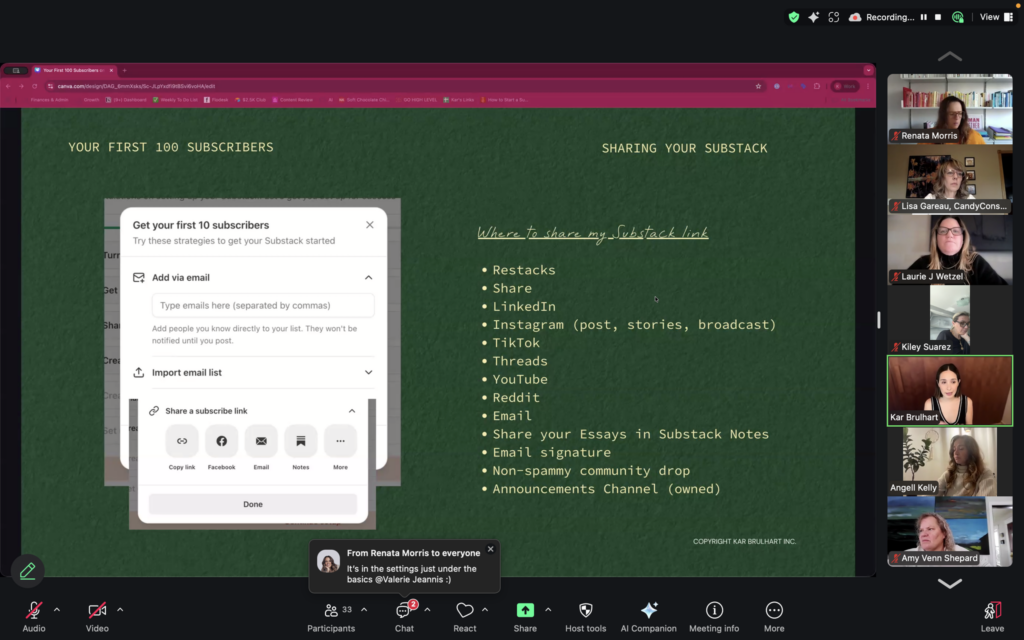
Your first 100 subscribers isn’t a content problem. It’s a clarity problem.
You don’t need a perfect setup. You need a home base and a place where your thinking can live without it feeling like it’s on rented land.
Here’s what a lot of us are bumping up against right now:
Instagram has become a slot machine.
The platform is increasingly interest-based and unpredictable. Having followers doesn’t guarantee distribution anymore. You can do everything “right” and still not know who will see your work.
At times content on Instagram can be short-lived on what feels like “rented land.”
This is true even if Instagram changes again (which it undoubtedly will). But I’m not all doom and gloom! I’m still banking on Instagram as my primary social platform for short-form content and I’m finding ways to go viral again and again nearly every week without doing trends.
So why Substack?
Substack doesn’t behave like Instagram where you’re constantly trying to “hit” the algorithm like a slot machine. It’s more like a few discovery lanes working together with email delivery is the core.
Think of it as your long-form home base: Substack is now your primary “home base” (a place you own/control,) for publishing in-depth, high-value articles and essays.
I’m deprioritizing Instagram as the starting point because while it’s amazing for discovery, the content has a short lifespan and the distribution is unpredictable.
Substack becomes our home base – the place where your ideas begin and live, and then Instagram becomes a distribution channel, not the foundation.
Here’s the relief: you don’t have to win the feed for it to work.
I need you to hear that again, because we’ve all been trained into dopamine dependence: You don’t need a thousand likes or thousands of followers to make money from your writing.
Some of my posts don’t get more than a handful of likes, and some Notes take a day or two before anyone engages. It can feel brutal at first if you’re used to Instagram’s immediate feedback loop, but rest-assured it happens to everyone!
That’s why I was shocked to see my Substack hit #87 in Culture this week (around 40ish days after being consistent with it and putting out high value pieces).
That’s why I keep telling people: don’t panic when it feels quiet! It’s working in the background, and it WILL be quiet at the start but it’s so important that you keep writing.
I’ve learned everything about Substack by doing. I haven’t taken a course, I haven’t paid anyone to teach me how to make $35K or $100k months or “sky rocket my followers” and so I’m sharing things I wish I had known when I first started.
Here are a few things I wish someone had told me before I started my Substack:
1) Do not import your entire email list just because Substack asks you to.
I didn’t import anyone. I wanted a challenge, and also to be able to grow a new audience without any expectations. You can import if you want, but do it intentionally. Only import people who opted in, and ideally start with your warmest segment (openers, clickers, current clients). Otherwise you risk bringing in people who don’t really want to be there, and you’ll feel that in the silence.
If you’re moving from another email platform, send a simple email first let people know you’re moving over to Substack and give them an option to opt-in.
Let people raise their hand.
2) Recommendations are free advertising.
Substack has built-in network effects, and they matter more than people realize.
Growth here doesn’t come from chasing the biggest names or begging massive accounts for attention. It comes from peers and from writers with adjacent audiences. From quiet trades that make sense.
You recommend someone and they recommend you, and suddenly your work is landing in front of readers who already like this kind of writing!
3) Notes are supportive, not foundational
Your essays won’t magically get pushed to strangers. Notes will do that.
The easiest way to use Notes without overthinking it:
highlight a snippet from your essay → post it as a Note → repeat
You can add the link to the article, you can add context to the snippet or just post the snippet like I did here:
If you’re already on Threads, you basically already have the muscle for Notes and you can easily repurpose your Threads here (you may want to change the tone or make them slightly different sometimes)
4) Consistency is the whole game.
If you publish once a month, Substack can still “work,” but it will be a lot slower. You’re competing with active writers in your niche, and Substack learns who you are through repetition.
If weekly feels like too much, start with weekly short posts. The point is a reliable rhythm, not a masterpiece.
5) Use AI like an editor, not as your voice.
Start with your own brain. Stream of consciousness. Pen and paper if that’s what helps you think clearly.
Then use AI like a red-pen editor: “this bridge is weak,” “this needs a better ending,” “this is unclear.”
If you start with AI, you will sound like everyone else and people can feel that now.
If you want a tool recommendation: MyStory Pro is what I use when I need an editor-style thought partner (not a robot that waters me down). It asks the right questions, tightens structure, and keeps your voice intact.
It’s also my friend Patrice Poltzer’s company and I trust her with storytelling. Patrice is a former TODAY Show producer who understands storytelling to the core. Instead of generic corporate-speak, you get content that maintains your voice and personality. It’s been my secret weapon for editing my essays once I’ve written them.
Try it here with code ‘KAR’ to save $5 on your subscription and get a 7 day free trial: https://mystorypro.ai/pocket-patrice?via=kar
I could keep going.
There’s a lot more to setting up a Substack that like having a punchy bio that converts subscribers, writing subscription benefits that convert, and building a content system so you’re not staring at a blank page every week wondering what to write.
But this post is already long, and if you want the full roadmap, I just taught all of it live (catch the recording of the training here)
Here’s what didn’t make it into this post
- How to write a bio that shows context, credibility, and payoff without sounding like a résumé or an “I help” statement
- How to write subscription benefits that don’t sound like everyone else’s ‘exclusive content.’How to structure your paid subscription benefits to upgrade and you don’t over-promise
- How to plan your content without burning out in month two and never wondering what to post using my LOB system
- How to build a writing and publishing rhythm that’s sustainable, even if you don’t post every day or love being online
- How to use Substack as your long-form home base with Instagram as distribution, not the foundation
- How to grow without chasing dopamine, vanity metrics, or pretending you’re a full-time creator.
We covered all of that in a live workshop – 90 minutes, fully practical, with real examples and live Q&A where people brought their actual Substacks and we workshopped them together
You’ll also get my AI prompts for finessing your writing, your bio and your subscriber benefits in a handy workbook. These are custom prompts I made and used for my Substack that make it easier to find your position, refine your writing, and monetize without overcomplicating it.
If that sounds useful, grab it. If not, use what’s in this post and run with it.

